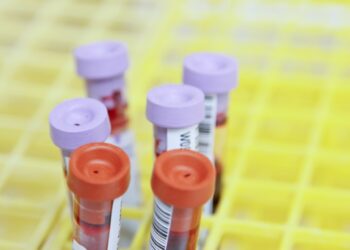
The founder of a world-leading company dedicated to improving outcomes for cancer patients though liquid biopsy blood tests has shared his views on why live cell liquid biopsies should become standard in oncology practice.
ANGLE plc founder and chief executive Andrew Newland (pictured) has overseen the launch of the company’s flagship rare cell separation and capture liquid biopsy platform, the Parsortix system.
ANGLE’s Parsortix system captures circulating tumour cells (CTCs). The resulting liquid biopsy enables the investigation of mutations in the patient’s cancer for personalised cancer care without the need for invasive tissue sampling.
Andrew said: “In 2025, we mark over 150 years since Australian physician Dr Thomas Ashworth made a groundbreaking observation that tumour cells were present in the blood of a cancer patient1.
“Despite the significance of this discovery, it would take over a century for science to fully grasp the implications of this finding, largely due to the considerable technical challenges associated with isolating these rare CTCs from billions of blood cells2.
“In the past two decades, game-changing advances in CTC isolation technologies and cell analysis techniques have transformed the CTC liquid biopsy landscape3.
“Technologies such as the Parsortix® system (ANGLE plc), have made it possible to rapidly and reliably isolate intact, living CTCs and CTC clusters from a single blood tube as a liquid biopsy.
“In parallel, downstream analysis methods, which were once limited to simple CTC enumeration, now include low cost, highly sensitive, high-throughput next generation sequencing (NGS) and PCR, FISH, and immunofluorescence imaging4.
“These innovations have revealed the extraordinary potential of CTCs to provide minimally invasive real-time, multiomic information for unparalleled insight into tumour biology.”
CTCs – A comprehensive tumour portrait
Andrew says liquid biopsies offer several distinct advantages over traditional tissue biopsies, which remain the current standard for tumour characterisation.
He said: “They are less invasive and much easier to obtain, more cost-effective, and deliver results more rapidly. Critically, as cancer evolves and changes, liquid biopsies are also better suited for longitudinal disease monitoring than traditional tissue biopsies3.
“CTCs are intact, living cancer cells that are shed into the bloodstream from primary or metastatic sites. CTCs preserve the complete spectrum of tumour-derived data including DNA, RNA, proteins, metabolites, and epigenetic features. This enables comprehensive multiomic analysis from a single blood sample. Notably, CTCs remain the only viable biomarker capable of providing such multi-dimensional data even after surgical removal of the primary tumour2.
“Cancer is a highly complex and heterogeneous disease, posing significant challenges to effective treatment. Research has shown that cancer development and progression are driven not only by genetic mutations but also by non-genetic transcriptomic and proteomic changes, which are equally critical5.
“Recent advances in high-throughput computational methods, including artificial intelligence and machine learning, now allow for unparalleled multiomic analysis. These technologies are transforming biomarker discovery, tumour classification, prognostic evaluation, treatment response prediction, and monitoring for recurrence5.”
Clinical applications driving integration
CTC-based multiomic approaches are poised to revolutionise cancer care by providing a more comprehensive understanding of cancer at a molecular level, leading to more accurate diagnoses, personalised treatment strategies, and improved patient outcomes6.
Potential clinical applications of CTCs include:
- Disease risk and prognosis – CTCs have been isolated and enumerated as a prognostic biomarker in multiple cancers and gene expression analysis of CTCs has been shown to accurately differentiate between early and late-stage cancer, providing a more effective predictor of disease as compared to gold standard biomarkersalone7.
- Therapeutic target selection – CTCs contain intact whole cancer genomes and transcriptomes. Mutational analysis can provide clinical targets for drug selection in multiple cancers. These targets have been shown to mirror matched metastatic tissue biopsy8.
- Monitoring treatment response and resistance – CTCs have been analysed to study mutations and track tumour evolution throughout the treatment process to assess treatment response and treatment resistance. This provides real-time insights to inform current and future drug selection9.
- Post treatment monitoring – Analysis of CTCs has the potential to enable detection of recurrence prior to standard of care and may predict impending relapse earlier than imaging and more accurately than serum markers10. This will allow for early interventions and adjustments to treatment strategies.
The road to routine use
Advances in marker independent CTC isolation technologies and multiomics mean live CTC profiling is now scalable and clinically feasible.
The Parsortix system (ANGLE plc), as an example of available liquid biopsy technologies, has been utilised in over 100 peer reviewed publications to isolate CTCs from 24 different cancer types, representing 90 per cent of all solid cancers.
Andrew said: “This wealth of translational research shows proof of concept for the assessment of CTCs to inform potential clinical applications in disease prognosis, therapeutic selection, resistance monitoring and recurrence monitoring across these various cancer types.
“More specifically, the identification of key therapeutic biomarkers such as HER2 and PD-L1 on CTCs isolated from the blood of breast and lung caancer patients2,11, points to liquid biopsy assessment of blood-based biomarkers holding vast potential for longitudinal monitoring of treatment response and therapy resistance where tissue is no longer available.
“Standardisation of CTC detection methods and establishing clear guidelines for their interpretation will enable integration with existing diagnostic modalities to provide a comprehensive picture of the patient’s disease throughout the care pathway and facilitate progression towards making liquid biopsy a reality in the clinical setting.”
Bibliography
- Ashworth, T. R. Hospital Reports:Melbourne Hospital. A case of cancer in which cells similar to those in the Tumours were seen in the blood after death. Aust. Med. J 14, 147–148 (1869).
- Smit, D. J. & Pantel, K. Circulating tumor cells as liquid biopsy markers in cancer patients. Mol. Aspects Med. 96, 101258 (2024).
- Narayan, P. et al. State of the Science and Future Directions for Liquid Biopsies in Drug Development. The Oncologist 25, 730–732 (2020).
- Wishart, G., Templeman, A., Hendry, F., Miller, K. & Pailhes-Jimenez, A.-S. Molecular Profiling of Circulating Tumour Cells and Circulating Tumour DNA: Complementary Insights from a Single Blood Sample Utilising the Parsortix® System. Curr. Issues Mol. Biol. 46, 773–787 (2024).
- Zhang, Y. W., Gvozdenovic, A. & Aceto, N. A Molecular Voyage: Multiomics Insights into Circulating Tumor Cells. Cancer Discov. 14, 920–933 (2024).
- Chakraborty, S., Sharma, G., Karmakar, S. & Banerjee, S. Multi-OMICS approaches in cancer biology: New era in cancer therapy. Biochim. Biophys. Acta BBA – Mol. Basis Dis. 1870, 167120 (2024).
- Moore, R. G. et al. Malignancy Assessment Using Gene Identification in Captured Cells Algorithm for the Prediction of Malignancy in Women With a Pelvic Mass. Obstet. Gynecol. 140, 631 (2022).
- Ring, A. et al. Circulating Tumor Cell Transcriptomics as Biopsy Surrogates in Metastatic Breast Cancer. Ann. Surg. Oncol. 29, 2882–2894 (2022).
- Silvestri, M. et al. Copy number alterations analysis of primary tumor tissue and circulating tumor cells from patients with early-stage triple negative breast cancer. Sci. Rep. 12, 1470 (2022).
10.Stergiopoulou, D. et al. Comprehensive liquid biopsy analysis as a tool for the early detection of minimal residual disease in breast cancer. Sci. Rep. 13, 1258 (2023).
11.Strati, A., Economopoulou, P., Lianidou, E. & Psyrri, A. Clinical Significance of PD-L1 Status in Circulating Tumor Cells for Cancer Management during Immunotherapy. Biomedicines 11, 1768 (2023).