The Royal Marsden has opened a pioneering cancer genomics centre in Sutton, designed to help more patients across the UK benefit from personalised cancer treatments and clinical trials.
The Royal Marsden Centre for Cancer Genomics is the first NHS facility designed to develop and deliver nationwide composite biomarker testing, which combines genetic information, imaging and other patient data to build a more detailed picture of an individual’s cancer.
Advancing personalised cancer care across the UK
Genomics has become a fundamental part of cancer care, helping clinicians diagnose disease earlier and match patients to the most effective therapies and clinical trials. By 2035, the UK Government anticipates half of all healthcare interactions will be informed by genomic insights and other predictive analytics. In this context, The Royal Marsden Centre for Cancer Genomics will help deliver on the ambitions of the UK’s National Cancer Plan by expanding the country’s genomic infrastructure and developing the expertise needed to support earlier diagnosis, more personalised treatment and improved access to clinical trials.
This new facility has been made possible by funding from The Royal Marsden Cancer Charity, including funding for the expansion of ctDNA testing at The Royal Marsden, as well as an infrastructure grant from the National Institute for Health and Care Research (NIHR).
How could the new testing benefit patients?
Historically, biomarker testing has involved finding a single indicator (e.g. a genetic mutation) and prescribing the patient a treatment tailored to that biomarker. However, this type of one-to-one matching has its limitations, and scientists cannot always reliably predict why some patients respond to a treatment while others do not.
In contrast, composite biomarker testing aims to build a fuller picture of a patient’s biology by combining multiple measurements (e.g. genetic mutations, immune signatures, features derived from imaging) and using machine learning to identify patterns that might otherwise be missed by the human eye. By analysing these different signals together, researchers hope to better understand which patients are likely to respond to certain treatments or combinations of drugs.
The Royal Marsden Centre for Cancer Genomics will act as a national biomarker facility for clinical trials, helping bring the latest composite biomarker studies to the UK and enabling samples to be tested from anywhere in the country. In practice, this could help more patients in different parts of the UK to access these highly tailored drug trials without needing to travel to a major cancer centre.
Using blood tests to personalise cancer care
The facility will also be dedicated to translational research, helping to bring promising innovations from the research laboratory into routine clinical practice more quickly, as well as next-generation circulating tumour DNA (ctDNA) testing and novel, personalised diagnostic pathways like MyTrack™ Myeloma. ctDNA testing is a blood-based ‘liquid biopsy’ that detects small fragments of tumour DNA in a person’s bloodstream to diagnose cancer, guide treatment and predict recurrence.
This builds on The Royal Marsden’s history of successfully translating similar innovations into a clinical setting, especially regarding ctDNA and genetic testing. In 2023, the Trust was the first in the NHS to deliver large-scale ctDNA testing and co-led a national pilot that received samples from hospitals across the country.
As the cancer testing laboratory for the North Thames Genomics Laboratory Hub – one of seven hubs in England – The Royal Marsden Centre for Cancer Genomics will allow the Trust to relocate and expand its ctDNA analysis programme. As well as supporting the wider adoption of this technology in patient care, the facility will also help evaluate new applications for ctDNA testing and explore how it can be integrated with other diagnostic measurements as part of composite biomarker testing.
By bringing together the NHS, academia and industry, The Royal Marsden Centre for Cancer Genomics will help accelerate the development and adoption of new diagnostic methodologies, attracting greater investment into the national and local economy, and supporting the UK’s position as a world leader in life sciences innovation.
Giving patients greater reassurance through personalised testing
Elaine Nangle, 45, from Reading, was diagnosed with stage 3 lobular breast cancer in March 2020. Following treatment which included chemotherapy, radiotherapy and a mastectomy, she received the news that she was cancer free and was given the opportunity to join the TRAK-ER trial at The Royal Marsden, which is supported by The Royal Marsden Cancer Charity. This trial monitors the risk of the cancer returning with a personalised ctDNA test every three months, for up to three years. If risk of relapse is indicated, the patient’s treatment will be altered to try and prevent relapse from happening.
She said: “To have such a simple blood test detect something like this, it’s incredible. It was just so reassuring to be part of something that may be able to give me forewarning of relapse, especially because the test is tailored to my specific tumour. Even just knowing that I’ve been monitored so frequently gives me a huge safety net. Anything that gives me a greater chance of being here for longer, and being well for longer, is amazing.”
The Royal Marsden Centre for Cancer Genomics will be part of a thriving life sciences campus alongside its long-standing academic research partner, The Institute of Cancer Research (ICR) and located within the context of the growing London Cancer District in Sutton.
Bringing the latest cancer research to patients
The new centre brings together clinical expertise, research and advanced technology, strengthening The Royal Marsden’s ability to develop new diagnostic approaches and make them available to patients across the NHS.
Dame Cally Palmer, Chief Executive of The Royal Marsden NHS Foundation Trust, said: “At The Royal Marsden, we are continuing to invest in the facilities, expertise, and technologies required to develop the next generation of cancer diagnostics, while continuing to deliver the highest standard of patient care. By bringing together world-leading cancer research, clinical expertise and patient care on a single campus, The Royal Marsden Centre for Cancer Genomics will help bring new diagnostics and genomic technologies into clinical practice faster, enabling more patients to benefit from life-saving treatments, while helping to accelerate innovation across the wider NHS.”
Professor Michael Hubank, Scientific Director of Clinical Genomics at The Royal Marsden NHS Foundation Trust and Professor of Translational Genomics at The Institute of Cancer Research, London, said: “Composite biomarker testing looks set to deliver on the promise of integrated diagnostics, compiling as many different types of data as is necessary to characterise the patient and their tumour and make an effective, truly personalised clinical decision.
“The Royal Marsden Centre for Cancer Genomics will create the capacity for us to develop and deliver these new, highly sophisticated tests, while extending the reach of our genomic expertise far beyond the bounds of our own hospitals. By helping to establish and support new diagnostic approaches across the country, we can ensure that more patients benefit from the most advanced cancer testing and the personalised treatments it enables.”
Together with its principal academic partner, the ICR, The Royal Marsden is designated as the UK’s only National Institute for Health and Care Research (NIHR) Biomedical Research Centre (BRC) dedicated solely to cancer. Funding from the NIHR BRC has supported a wide range of cancer research at The Royal Marsden and the ICR.
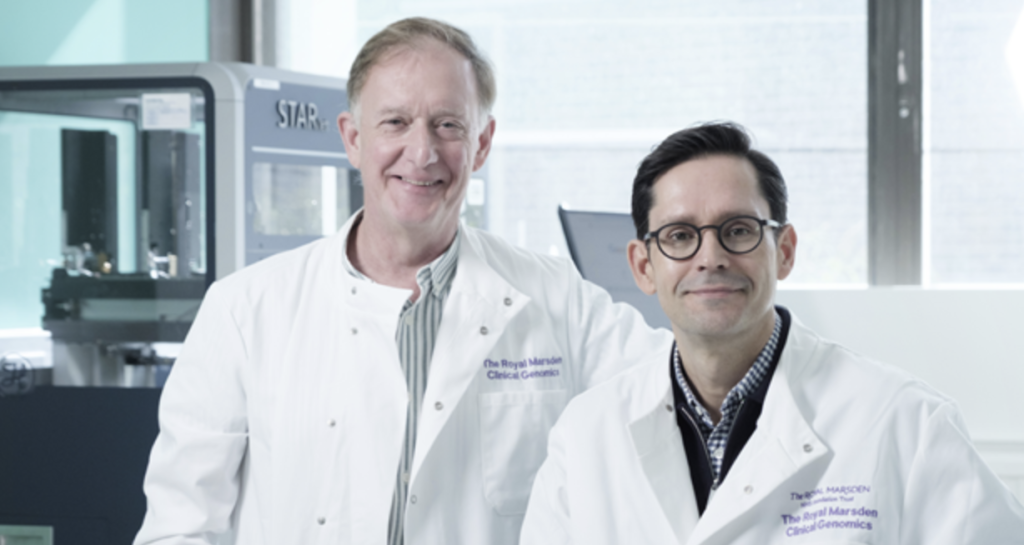
Pictured: Professor Michael Hubank, Scientific Director of Clinical Genomics and Dr Mikel Valgañón-Petrizan, Head of Clinical Genomics